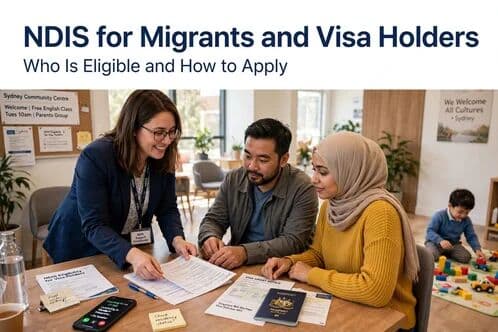
Picture this. You moved to Sydney a few years ago on a work visa. Life finally feels steady. Then your child gets a diagnosis, or your mum has a stroke, or an accident changes everything for you. Someone says, “Just apply for the NDIS.” And your first thought isn’t about forms or doctors. It’s, “Does my visa even count?”
That question trips up a lot of newcomers, and it’s a fair one. The National Disability Insurance Scheme (NDIS) checks your residency status before it looks at almost anything else, and the rules aren’t obvious if you didn’t grow up here. So let’s go through it properly: who qualifies, who doesn’t, how to apply if you do, and where to turn if the answer is no.
This guide is general information, not legal or immigration advice. If your visa situation is complicated, a registered migration agent can look at your case.
What Are the NDIS Eligibility Requirements?
Every Australian with a disability was never intended to be supported by the NDIS. The NDIS is designed to cooperate with the health, education, housing, and social security sectors, each of which bears a portion of the burden. The National Disability Insurance Agency (NDIA) administers the same three exams to all applicants to maintain this status.
You have to meet the age and residency tests before the NDIA even gets to your medical evidence. That’s why visa status matters so much, and why this guide spends most of its time there.
What Are the Residence Requirements?
The residence rule comes from the NDIS Act itself, so nobody at the NDIA can bend it. It has two parts.
- Part one is your legal status. You need to be an Australian citizen, a permanent resident (holding a permanent visa), or a holder of a Protected Special Category visa.
- Part two is where you actually live. Australia has to be your home, and you need to spend most of your time here. The NDIA looks at your whole situation. It might ask:
- Where do you live most of the time?
- Where does your family live?
- Do you work in Australia?
- Do you own property here?
- How much time do you spend overseas?
There’s no single magic answer. A person who works, rents and has family in Sydney but visits their home country for a few weeks each year will usually look very different from someone who spends most of the year abroad.
NDIS Eligibility by Visa Type
Here’s a quick reference. Always check your own visa grant letter or your VEVO record on the Department of Home Affairs website, because the details of your visa matter more than its nickname.
How to tell if your visa is permanent
Examine the letter granting your visa. You can remain in Australia permanently if you have a permanent visa. A temporary visa has terms and an expiration date. Check VEVO or consult a registered migration agent if you’re not sure. Applying under the incorrect assumption can take months, so don’t guess.
Can I Access the NDIS on a Temporary Visa?
No, not at the moment. It’s the most common question we hear, and it’s a frustrating answer, so it’s worth explaining why.
The NDIS is a national scheme funded and governed by the Australian Government together with the states and territories. The law that sets it up says you need to be a citizen, a permanent visa holder or a protected Special Category visa holder. It doesn’t matter how long you’ve lived here, how much tax you’ve paid or how serious your needs are. Temporary visa holders, including international students, skilled workers and people seeking asylum, fall outside that rule.
People on temporary visas do still pay into some parts of the system, such as the Medicare levy for those who are liable for it, and that’s a point disability advocates have raised for years. For now, though, the rule stands, so the practical question becomes: what else can you use? We cover that in a later section.
What If My Visa Status Changes?
This is where timing matters. The NDIA checks your eligibility when you apply, so the day your permanent visa or citizenship is granted is the day you can start.
A few practical tips:
- Start collecting evidence now. Reports from your GP, specialists, psychologists or therapists take time to get, and you can have them ready before your visa changes.
- Apply soon after your status changes. There’s no reason to wait once you meet the residence rule.
- New Zealand citizens have a clearer pathway than before. Since 1 July 2023, some New Zealand citizens who have lived in Australia for at least four years can apply directly for Australian citizenship. The NDIS rules themselves didn’t change, but becoming a citizen would meet the residence requirement.
- Children born in Australia. Citizenship rules for children born here to temporary visa holders are tricky. If your child was born in Australia, ask a migration agent whether they have a claim to citizenship, since citizens under 9 can access early childhood support.
Living in Australia and Travelling Overseas
Many migrants travel home regularly, so this one matters.
You can travel abroad and continue to use your assistance for up to six weeks after becoming an NDIS member. This is referred to as a grace period by the NDIA. You must first get in touch with the NDIA if you will be gone for more than six weeks and require your funding during that time. You would have to let them know how long you want to stay abroad, why you’re going, what kind of assistance you’ll need, and why you need money to travel. The decision to prolong the grace period will be made by them. You could no longer be able to meet the residency requirement if you spend the majority of your time outside of Australia. For this reason, it’s important to keep accurate travel logs.
How to Check Your Eligibility Before You Apply
Before you start the paperwork, run through this short checklist. The NDIA’s own website has an eligibility checker too, and it’s a good place to begin.
- Identity: The NDIA needs to see three different identity documents, showing your name, address, date of birth and a photo.
- Age: You must be under 65 on the day you apply. If you’re turning 65 soon, call the NDIA early so they can help you apply in time.
- Residence: Confirm you’re a citizen, permanent visa holder or protected SCV holder, and that Australia is your home.
- Disability: Think about whether your impairment is likely to be permanent and whether it significantly affects things like moving around, communicating, looking after yourself, studying or working.
- Early intervention: If your condition may not be permanent yet, ask whether early support could reduce your future needs.
Evidence of your age and residency
Giving the NDIA permission to see your Centrelink record is the simplest option. It will only be used to verify your age and place of residence. You can provide documentation if you’d prefer not to or if you don’t have a Centrelink record. A driver’s licence, passport, or birth certificate could be used to prove age. The NDIA requires proof that you live in Australia and spend the majority of your time here, together with one birth or arrival document, such as a passport or Australian citizenship certificate, in order to grant residency.
How to Apply for the NDIS Step by Step
The process looks long on paper, but each step is manageable.
Step 1: Talk to someone first. Call the NDIA on 1800 800 110, or contact a local area coordinator (for ages 9 and over) or an early childhood partner (for children under 9). They’ll help you understand what evidence to bring. If you need an interpreter, see the language section below.
Step 2: Make an Access Request. This is the formal application. You can complete the Access Request Form with help from your partner or the NDIA.
Step 3: Gather your evidence. You’ll usually need:
- Your identity, age and residency documents
- Reports from doctors, specialists, psychologists or allied health professionals
- Written descriptions of how your disability affects daily life
A useful tip is to ask your treating professionals to be specific. What can’t you do without support? What help do you already get from family? What would you need to take part in community life, study or work? Family support counts as evidence too, even though it’s informal.
Step 4: Wait for the decision. The NDIA generally aims to decide within 21 days of having everything it needs, but it often takes longer if it asks for more information. From start to finish, many people find the whole process takes a few months.
Step 5: Planning meeting. If you’re approved, you’ll meet a planner or local area coordinator to build your NDIS plan. This is where the supports and funding are decided.
What about children under 9?
Children under 9 go through the early childhood approach, which helps children under 6 with developmental delay and children under 9 with disability. The same residence rule applies to kids, so the child’s own citizenship or visa matters, not just the parents’.
Language Help and Cultural Barriers
Let’s be honest about something that rarely appears in official guides: for many migrant families, the hardest part isn’t the form. It’s the language, the unfamiliar system, and sometimes the feeling that asking for help is somehow shameful.
- You don’t need perfect English. You can get a free interpreter. Call the Translating and Interpreting Service (TIS National) on 131 450, tell them your language, and ask to be connected to the NDIS on 1800 800 110. You can also ask for an interpreter when you book a meeting with a local area coordinator or planner, and you’re allowed to ask for a specific interpreter.
- Bring someone with you. A trusted family member, friend or advocate can come to meetings, help you understand what’s being asked and speak up for you. A nominee can be formally appointed to act for a person with disability.
- Disability isn’t something to hide. In many cultures, disability carries stigma, and families sometimes avoid support because of it. In Australia, getting help for disability is a right, not a source of shame. The NDIA has also published a strategy to make the scheme work better for culturally and linguistically diverse (CALD) communities, because participation among these groups has historically been lower than it should be.
Support for Carers
If you’re caring for someone with disability, you matter too. Carer Gateway offers free counselling, peer support and respite services, and you can call them on 1800 422 737. Carer payments and allowances through Services Australia have their own residence rules, so check those separately. If your family member becomes an NDIS participant, their plan may include respite, which gives you a break while they’re cared for.
What If You’re Not Eligible? Other Support Options
If the NDIS isn’t open to you yet, don’t stop there. Here’s what’s worth exploring.
- State and territory programs. These vary a lot. South Australia, for example, has committed $11.6 million over five years for people with disability who can’t access the NDIS because of their visa status, including people on bridging visas, Temporary Protection visas and some New Zealand citizens. Victoria has programs such as VIN-CoS for people over school entry age and ECIS-CoS for younger children, though they are small, are a last resort, and VIN-CoS isn’t open to student visa holders. In Victoria’s early childhood pathway, you first have to apply to the NDIS and receive a formal rejection.
- Specific services. Hearing Australia, for instance, has a stream for children on temporary resident visas who have permanent hearing loss.
- Community and settlement organisations. Many offer casework, advocacy and referrals, and some will help with interpreters and paperwork.
- Your GP, hospital social worker or community health team. They often know what’s available locally.
- Private or self-funded support. Some providers let you pay directly without NDIS approval.
- A migration agent. If your goal is permanent residency, ask how disability may affect your visa pathway, since health requirements apply to some visa applications.
We couldn’t confirm a dedicated NSW program like South Australia’s, so if you’re in Sydney, ask the services above what’s available right now.
What to Do If Your NDIS Application Is Rejected
A “no” isn’t always the end. You have the right to ask for a review.
- Internal review. Ask the NDIA to review its decision within three months of being told. A different staff member will look at it again.
- External review. If you’re still unhappy, you can apply to the Administrative Review Tribunal, which reviews NDIA decisions. It arranges a free interpreter if you ask.
- Advocacy support. Free disability advocacy organisations can help you prepare.
The most common reasons for rejection are weak evidence of the impact on daily life, a disability that isn’t shown to be permanent, and residency requirements that aren’t met. If it’s an evidence problem, ask your treating professionals for more detailed reports, then reapply.
What’s Changing in 2026 and Beyond
If you’ve been reading the news, you’ll know the NDIS is being reformed. Parliament passed major changes in August 2026. The reforms tighten access by changing how need is assessed, introducing stricter rules to show that a disability is permanent, and allowing automated tools to help assess eligibility and plan supports. The eligibility changes take effect from January 2028, and people already on the scheme will begin to be reassessed from 2028, gradually over three years.
For migrants, here’s what that means in practice. We haven’t seen anything suggesting the residency rule itself is changing. What is changing is the way disability and functional capacity are assessed, so strong, specific evidence will matter more than ever. Much of the detail is still being worked out, so check the NDIA website for updates before you apply.
Final Thoughts:
If there’s one thing to take from all of this, it’s that the NDIS visa rule is strict, but it isn’t the whole story. The three eligibility tests (age, residency and disability) are the same for everyone. If you’re a citizen, a permanent visa holder or a protected Special Category visa holder, you can apply, and the rest comes down to evidence and patience. So if you’re eligible, don’t wait: call the NDIA or your local area coordinator, ask for an interpreter if you need one, and start collecting evidence. Be specific about what you can’t do without support, and include the help your family already gives you. If you’re close to eligible, for example, waiting on a permanent visa or about to become a citizen, use that time to gather your medical reports, keep your documents together and record your travel, so you can apply the same week your status changes.
If you’re not eligible, it’s still worth acting. Ask your GP and social worker about local services, look at what your state offers, contact community and settlement organisations, and speak with a migration agent about your path to a permanent visa. No matter which group you’re in, please don’t do this alone. Use the free interpreter service, bring a trusted person to your meetings and keep asking questions until it makes sense. Disability support isn’t charity or a favour. It’s something Australia built for people who need it, and learning the rules is the first step to getting what you’re entitled to. Rules and programs change, so check the NDIS website and your state government’s disability pages before you apply, and treat this guide as a starting point rather than the final word.
Frequently Asked Questions
I’m on a temporary visa in Sydney. Is there any disability support I can get?
The NDIS rules are national, so Sydney isn’t different from anywhere else. On a temporary visa, you can’t join the NDIS. We couldn’t confirm a dedicated NSW program for temporary visa holders, like those in South Australia and Victoria, so the best approach is to ask. Start with your GP, a hospital or community health social worker, your local council and community or settlement organisations. If you hope to become a permanent resident, speak with a migration agent too, because once you hold a permanent visa, you can apply to the NDIS.
Where can I get free help applying for the NDIS in my own language in Sydney?
Start by finding your local NDIS partner on the NDIS website’s locations page, and ask for an interpreter when you book. You can also call TIS National on 131 450 and ask to be connected to the NDIS. In Sydney, the Multicultural Disability Advocacy Association of NSW (MDAA), based in Granville, supports people with disability from culturally and linguistically diverse backgrounds, and you can reach them on 1800 629 072. Check their website for current contact details.
I came to Sydney as a refugee. Does my visa type change whether we can get the NDIS?
Yes, it does. Refugees on permanent humanitarian visas can apply for the NDIS. People on Temporary Protection or Safe Haven Enterprise visas, and people on bridging visas while they wait for a decision, can’t. Many newly arrived people with disability settle in Sydney, so you’re far from alone, and refugee support organisations in the city can help you work out your options and your next visa step.
Can I get the NDIS on a student visa, work visa or bridging visa?
No. These are all temporary visas, and the NDIS is only open to Australian citizens, permanent visa holders and protected Special Category visa holders. If you’re on one of these visas, look into state programs, community services and private options, and apply to the NDIS once you hold a permanent visa.
Do I need to be an Australian citizen, or is permanent residency enough?
Permanent residency is enough. You don’t have to be a citizen. A permanent visa holder who lives in Australia, is under 65 and meets the disability or early intervention requirements can apply.
Can I keep using my NDIS plan if I travel overseas or move back home?
You can use your supports overseas for up to six weeks. After that, you’d need to contact the NDIA and ask for an extension, explaining how long you’ll be away and why you need the funding. If you move overseas for good, you’d no longer meet the requirement to live in Australia, so your access could end.